
What Is Your Topics | Multiple Stories? – Complete Definition
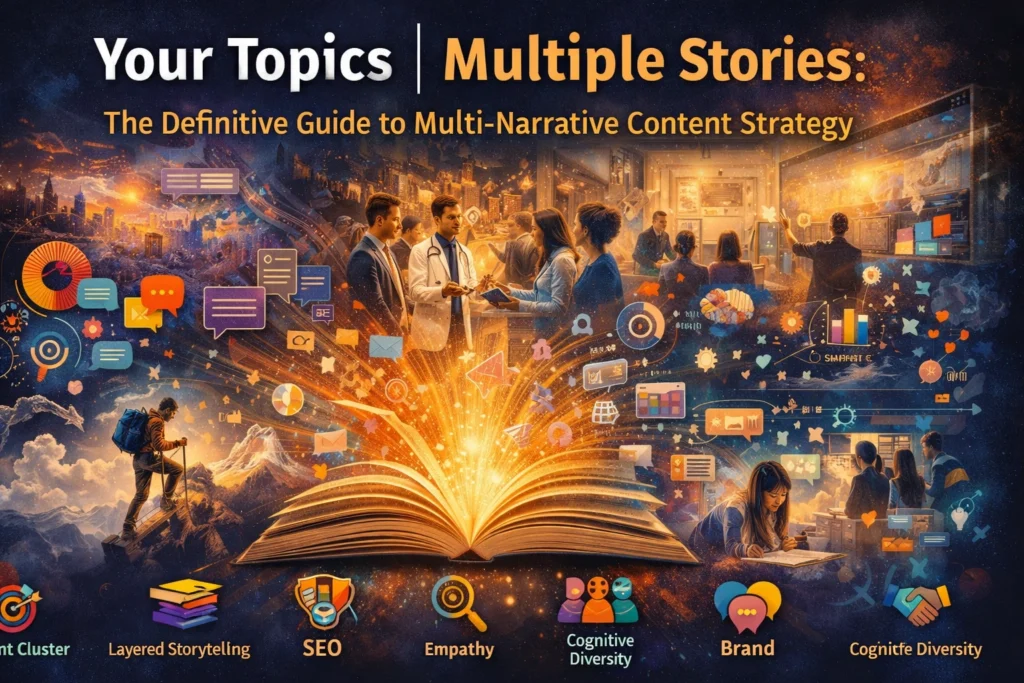
‘Your Topics | Multiple Stories’ is a content creation philosophy, educational methodology, and storytelling framework built on a single powerful idea: every subject worth discussing contains not one story, but many. Rather than reducing a topic to a single narrative or viewpoint, this approach deliberately identifies and develops multiple angles, voices, and formats — each capable of speaking to a different type of reader, learner, or audience member.
At its simplest, if your topic is climate change, you do not write one article. You write the scientist’s story, the coastal farmer’s story, the policymaker’s story, the teenager’s story, and the historian’s story. Each is distinct. Each is true. Together, they form a richer, more complete picture than any single narrative could.
The term has gained significant traction across multiple domains: content marketing, education, brand storytelling, journalism, fiction writing, and SEO strategy. It reflects a fundamental shift in how information is consumed in the digital age — people no longer want one definitive answer; they want depth, variety, and the freedom to find the angle that resonates with their own experience.
Four Dimensions of the Concept
- As a Content Strategy: A deliberate framework for building content clusters where each piece addresses the same core topic from a different narrative angle.
- As an Educational Method: A classroom and curriculum approach that teaches complex subjects through layered perspectives, case studies, and lived experiences.
- As an SEO Technique: A method of naturally building topical authority, long-tail keyword coverage, and semantic depth across a content ecosystem.
- As a Storytelling Philosophy: A commitment to the idea that diverse voices, formats, and perspectives create more honest, empathetic, and impactful communication.
The Origin & Evolution of Multi-Story Content
The concept of telling multiple stories about a single subject is ancient. Homer’s Iliad presents the Trojan War through dozens of individual perspectives. The Bible tells humanity’s relationship with the divine through the eyes of prophets, kings, ordinary people, and poets. The Rashomon effect — named after Akira Kurosawa’s 1950 film — describes how the same event can be honestly narrated by different witnesses in genuinely different ways.
In modern media, the evolution accelerated with the rise of long-form journalism in the 1960s and 1970s, when writers like Tom Wolfe and Gay Talese began presenting complex social realities through the lens of individual human stories. This tradition carried forward into documentary filmmaking, podcast storytelling, and eventually digital content.
The digital revolution created a decisive turning point. When content moved online, audiences gained the power to choose their own paths through information. A reader no longer had to accept the single perspective offered by a newspaper editorial — they could click through to the farmer’s blog, the scientist’s thread, and the economist’s analysis within minutes. Creators who understood this shift began deliberately designing content ecosystems that served all of these readers simultaneously.
Today, ‘Your Topics | Multiple Stories’ represents the maturation of this evolution — a recognized, teachable, and strategically deployable framework that any content creator, educator, or brand can apply systematically.
Why Multiple Stories on One Topic? — The Psychology & Science
The case for multiple stories is not merely practical — it is rooted in how human brains actually process, remember, and act on information.
The Neuroscience of Storytelling
Research in cognitive neuroscience consistently shows that stories activate more regions of the brain than facts alone. When we hear a statistic, the language-processing areas activate. When we hear a story, sensory, motor, and emotional regions also engage — the brain ‘lives’ the story rather than simply recording it. Multiple stories around one topic multiply this effect, creating a richer neural map of the subject that makes understanding deeper and retention longer.
Cognitive Diversity in Audiences
No two readers process information identically. Some people are analytical — they want data, frameworks, and logical argument. Others are experiential — they learn through narrative and example. Still others are social — they understand through other people’s stories and relationships. A single content piece can only serve one of these groups well. Multiple stories serve all of them.
The Empathy Dividend
Exposure to stories from perspectives different from our own activates empathy in measurable ways. Multiple stories around a single topic do not just inform — they expand the reader’s capacity to understand experiences unlike their own. This creates an emotional bond with the content and, by extension, with the creator or brand behind it. Audiences who feel understood and expanded by your content become loyal, returning readers.
Why This Matters for Engagement
| Audience Type | What They Need | Story Format That Works | Result |
| Analytical Reader | Data, logic, frameworks | Case studies, research summaries | Trust & authority |
| Emotional Reader | Personal connection, relatability | Personal narratives, lived stories | Empathy & loyalty |
| Visual Learner | Images, patterns, structures | Infographics, story diagrams | Memory retention |
| Social Learner | Community, shared experience | Interview-style, testimonials | Community building |
| Expert Reader | Depth, nuance, advanced insight | Long-form analysis, expert Q&A | Thought leadership |
| Beginner Reader | Simplicity, context, accessibility | Explainer stories, step-by-step | Audience growth |
Core Framework: How It Works Step by Step
Implementing the ‘Your Topics | Multiple Stories’ strategy is not about randomly producing more content. It requires a deliberate, structured process that begins with deep topic understanding and ends with interconnected, mutually reinforcing narratives.
Step 1 — Choose a Core Topic with Depth
The best topics for multi-story treatment share three qualities: they are broad enough to branch into sub-narratives; they contain genuine complexity that a single story cannot exhaust; and they carry stakes — something meaningful is at risk or in question. Sustainable agriculture, mental health in the workplace, artificial intelligence in education, and immigration are all examples of topics with natural multi-story depth.
Step 2 — Map the Stakeholder Ecosystem
Every meaningful topic involves multiple stakeholders whose experiences of it differ significantly. For a topic like ‘remote work,’ the stakeholders include the employee, the manager, the parent, the person with a disability, the urban professional, and the rural worker. Each has a genuine story. Mapping these stakeholders before writing ensures that no important perspective is missed.
Step 3 — Identify Story Angles
- The Personal Story: Individual lived experience — intimate, emotional, specific
- The Expert Story: Specialist insight — authoritative, evidence-based, nuanced
- The Historical Story: How we got here — contextual, pattern-revealing, consequential
- The Future Story: Where this is heading — speculative, visionary, actionable
- The Contrarian Story: The perspective that challenges consensus — thought-provoking, clarifying
- The Data Story: Numbers that reveal unexpected truths — precise, surprising, memorable
- The Cultural Story: How different communities experience this topic differently
Step 4 — Choose Formats for Each Story
Different story angles work best in different formats. Personal stories excel as first-person essays or video interviews. Data stories work as infographics or analytical posts. Historical stories lend themselves to long-form explainers or documentary-style videos. Match format to angle, and both will perform better.
Step 5 — Connect the Stories
The most powerful multi-story ecosystems are internally linked. Each story references others, creating a web of content that keeps readers in your ecosystem longer. A reader who enters through the personal story should be invited, naturally, to explore the expert story. Someone who found you through the data story should find the cultural story waiting for them. Connection is what transforms a collection of stories into a content strategy.
“One topic. Many stories. Every story a door. Every door leads back to you.”
Types of Stories You Can Tell Around One Topic
Understanding the range of story types available to you is essential for making full use of the ‘Your Topics | Multiple Stories’ framework. The following taxonomy covers the most effective narrative categories in use today.
| Story Type | Definition | Best Used When | Example (Topic: AI in Healthcare) |
| Personal Narrative | First-person account of lived experience | You want emotional connection and relatability | A nurse describes how AI changed her workflow |
| Expert Analysis | Specialist insight grounded in evidence | You need to build authority and trust | A radiologist explains AI diagnostic accuracy |
| Case Study | Detailed real-world example with outcomes | You want to demonstrate practical application | How Hospital X reduced errors by 40% using AI |
| Historical Context | How the topic developed over time | Audience lacks background knowledge | A timeline of AI in medicine from 1960 to today |
| Contrarian View | A perspective that challenges the mainstream | You want to stimulate critical thinking | Why some doctors refuse to trust AI diagnoses |
| Data-Driven Story | Statistics and research findings told as narrative | You need to make numbers human and memorable | The statistic that changed how we think about AI errors |
| Cultural Perspective | How different communities experience the topic | You serve a diverse or global audience | How AI healthcare tools differ across rural vs. urban India |
| Future Narrative | Projections, possibilities, and scenarios | You want to inspire action or investment | What AI-powered medicine could look like in 2040 |
Your Topics | Multiple Stories in Education
Educators were among the earliest adopters of multi-story methodology, though they often described it differently — as ‘multiple perspectives,’ ‘primary source analysis,’ or ‘differentiated instruction.’ The modern ‘Your Topics | Multiple Stories’ framework gives these long-standing educational instincts a unified name and a more transferable structure.
Why It Transforms Learning
- Deeper comprehension: When students encounter a topic through several narratives, they build more complex mental models than single-source instruction can produce.
- Critical thinking: Comparing stories that differ in perspective or conclusion forces students to evaluate evidence, question assumptions, and form their own conclusions.
- Inclusive engagement: Different students connect with different stories. A child who cannot relate to a textbook account of a historical event may connect powerfully with a personal letter from someone who was there.
- Ethical development: Exposure to diverse stories cultivates empathy and helps students understand that their own perspective is one of many valid viewpoints.
Practical Classroom Applications
Teaching the Second World War through a soldier’s diary, a civilian’s ration book, a Jewish family’s correspondence, and a journalist’s dispatch does something no single textbook can: it makes the event feel lived rather than studied. Students remember it differently because they experienced it differently.
Science teachers using this approach present a discovery like the germ theory of disease through: the data story (Pasteur’s experiments), the resistance story (why doctors initially rejected it), the personal story (a patient whose life was saved), and the future story (how it transformed modern medicine). The result is understanding that sticks.
Brand & Content Marketing Applications
For brands, ‘Your Topics | Multiple Stories’ is one of the most powerful content marketing strategies available — precisely because it respects audience diversity while building consistent topical authority.
How Brands Apply the Framework
- Customer story: The lived experience of a real person using the product or navigating the problem it solves.
- Founder story: The origin narrative — why this problem mattered enough to build a company around it.
- Data story: The research, surveys, or industry statistics that prove the problem is real and significant.
- Behind-the-scenes story: How the product, service, or solution is actually made — building trust through transparency.
- Community story: How multiple customers across different backgrounds connect through a shared challenge or aspiration.
- Expert story: Third-party authorities who validate the brand’s claims and approach.
Real-World Brand Examples of This Strategy
Netflix is the canonical example of multi-story content strategy. Rather than telling one story about a character, they build entire worlds — multiple seasons, multiple character backstories, multiple timelines — around a single narrative universe. Audiences who enter through one story find dozens of others waiting for them.
Patagonia, the outdoor clothing brand, applies this approach to its environmental advocacy. They tell the scientist’s story about glacial retreat, the activist’s story about legal battles, the customer’s story about a lifelong relationship with wilderness, and the founder’s story about why business must serve the planet. Each story speaks to a different segment of their audience while all pointing toward the same core values.
SEO Benefits: Why Google Loves This Strategy
From a search engine optimization perspective, the ‘Your Topics | Multiple Stories’ approach is one of the most effective ways to build lasting organic visibility. It aligns naturally with the way Google’s algorithms evaluate content quality, relevance, and authority.
Topical Authority
Google’s ranking systems increasingly reward websites that demonstrate comprehensive expertise in a subject area — what SEO practitioners call ‘topical authority.’ A site with fifteen deeply researched stories about sustainable agriculture, each approaching the topic from a distinct angle, signals to Google that this site genuinely understands the subject. A site with one comprehensive but isolated post does not achieve the same effect.
Long-Tail Keyword Coverage
Each story angle you develop naturally incorporates different vocabulary, questions, and semantic variations around your core topic. A personal story about sustainable farming uses words like ‘my soil,’ ‘crop rotation,’ and ‘family farm.’ An expert analysis uses ‘regenerative agriculture,’ ‘carbon sequestration,’ and ‘biodiversity indices.’ A policy story uses ‘agricultural subsidies,’ ‘land use legislation,’ and ‘food security frameworks.’ Together, these stories cover hundreds of search queries that no single piece could address.
User Engagement Signals
Google measures how users interact with content: how long they stay, whether they click to other pages, whether they return. Multiple interconnected stories create a web that keeps engaged readers on your site longer, signals quality to search algorithms, and increases the probability of return visits. All of these are positive ranking signals.
SEO Impact Summary Table
| SEO Factor | How Multiple Stories Help | Impact Level |
| Topical Authority | Multiple deep pieces signal comprehensive expertise | Very High |
| Long-tail Keywords | Different stories naturally cover semantic variations | High |
| Internal Linking | Stories link to each other, distributing page authority | High |
| Dwell Time | Engaged readers stay longer and explore more | High |
| Content Freshness | New story angles keep publishing cadence active | Medium |
| Featured Snippets | FAQs and how-to stories target position-zero opportunities | Medium |
| E-E-A-T Signals | Expert and case study stories demonstrate real expertise | Very High |
| Backlink Acquisition | Diverse stories attract links from varied sources | Medium-High |
Platforms & Formats: Where & How to Apply It
The ‘Your Topics | Multiple Stories’ strategy is not confined to written blog content. It is platform-agnostic and format-flexible — one of its greatest practical strengths.
| Platform | Best Story Formats | Audience Behavior | Pro Tip |
| Blog / Website | Long-form essays, case studies, expert analysis | Deep reading, research intent | Link stories in a content cluster |
| Personal micro-stories, visual narratives, carousels | Quick consumption, emotional scan | Use carousels to tell one story per slide | |
| YouTube | Documentary-style, personal stories, expert interviews | Lean-back, immersive viewing | Create a series playlist around one topic |
| Professional stories, data narratives, case studies | Career/business intent | Position expert stories for thought leadership | |
| Podcast | Conversational storytelling, interview-based | Deep listening, multitasking | Invite guest storytellers for diverse angles |
| Email Newsletter | Curated story roundups, personal letters | Loyal audience, high intent | Send each story angle as a separate edition |
| Classroom/Training | Case studies, primary sources, role-play scenarios | Learning with recall intent | Use parallel stories for comparison exercises |
| Presentations | Sequential slides, one story per section | Meeting/conference context | Open with personal story; close with data story |
Key Differences: Multi-Story vs. Single-Story Content
Understanding what distinguishes the ‘Your Topics | Multiple Stories’ approach from conventional single-story content creation is essential for appreciating its strategic value.
| Dimension | Single-Story Approach | Your Topics | Multiple Stories |
| Audience reach | Speaks to one audience segment | Speaks to multiple segments simultaneously |
| Depth of understanding | Covers one perspective | Builds holistic, multi-dimensional understanding |
| SEO coverage | Targets a narrow keyword range | Naturally covers a broad semantic keyword ecosystem |
| Content lifespan | Single piece, limited shelf life | Interconnected pieces that amplify each other over time |
| Engagement | Readers consume and leave | Readers explore multiple pieces, extending session time |
| Trust signals | One data point of expertise | Multiple proof points across formats and angles |
| Empathy building | Limited — one viewpoint only | Strong — multiple voices create emotional breadth |
| Content production | Efficient but shallow | Requires planning but creates compounding returns |
| Linking structure | Standalone piece | Network of mutually reinforcing content |
| Google E-E-A-T score | Demonstrates experience in one story | Demonstrates expertise across a full topic landscape |
Common Challenges & How to Overcome Them
Like any sophisticated strategy, ‘Your Topics | Multiple Stories’ comes with real challenges. Recognizing them in advance — and knowing how to navigate them — is what separates creators who implement this approach successfully from those who get stuck.
Challenge 1: Story Fragmentation
When multiple stories are not connected by a clear central theme, readers feel confused rather than enriched. The solution is to anchor every story explicitly to the core topic. Each piece should be able to stand alone AND make clear how it relates to the broader narrative ecosystem.
Challenge 2: Repetition Without Depth
Producing multiple stories on a topic is only valuable if each story adds something genuinely new. Rephrasing the same content in different words is not multi-story strategy — it is content inflation. Every story angle must offer a perspective, fact, or emotional experience unavailable in the others.
Challenge 3: Losing the Audience’s Thread
Readers who enter through one story may not naturally find the others. Address this with strong internal linking, content series labeling, and clear calls to action that invite readers toward related stories. A well-designed content hub page that organizes all stories around a topic helps enormously.
Challenge 4: Resource Intensity
Creating multiple high-quality stories requires more time and resources than producing a single piece. The solution is strategic planning: map all intended stories before producing any of them, repurpose material across formats, and publish stories sequentially rather than all at once.
Challenge 5: Maintaining Consistent Quality
The breadth demanded by multi-story content creation can tempt creators to lower their standards for some stories to meet publishing deadlines. Consistency of quality across all stories is non-negotiable — one weak piece in the network undermines the authority of all the others.
Frequently Asked Questions (FAQs)
Q What does ‘Your Topics | Multiple Stories’ mean?
‘Your Topics | Multiple Stories’ is a content strategy and storytelling framework that involves developing multiple distinct narratives, each addressing a different angle, perspective, or audience segment, all centered on the same core subject. Rather than telling one story and moving on, it systematically explores a topic through personal narratives, expert analysis, historical context, data stories, cultural perspectives, and more — creating a rich, multi-dimensional content ecosystem.
Q Why do multiple stories perform better in SEO than a single article?
Multiple stories build topical authority — the quality Google uses to determine whether a website is a genuinely expert resource on a subject. Each story adds new semantic keywords, answers different search queries, attracts links from different sources, and creates internal linking opportunities that distribute authority across your site. A network of interconnected stories also improves user engagement metrics, which Google interprets as quality signals.
Q How many stories should I create for one topic?
There is no magic number, but most SEO and content strategists recommend a minimum of three to five distinct story angles before a topic begins to build meaningful topical authority. Highly competitive topics may require ten or more interconnected pieces. More important than quantity is genuine distinctiveness — each story must offer perspectives or insights not available in the others.
Q Can a single piece of content contain multiple stories?
Yes, and in fact some of the most powerful content pieces do exactly this — presenting two or three contrasting stories in parallel to illuminate a topic from different angles simultaneously. However, when stories are given their own dedicated pieces, they can each be optimized individually for different keywords and reader intents, which is usually more effective for SEO.
Q What is a story with multiple perspectives called?
In literary criticism, a narrative told from multiple perspectives is called a ‘polyphonic’ or ‘multi-perspectival’ narrative. The technique was formally identified by literary theorist Mikhail Bakhtin. In journalism, it is known as ‘mosaic journalism’ or ‘panoramic reporting.’ In content marketing, ‘Your Topics | Multiple Stories’ describes the same concept applied to digital content strategy.
Q Is this approach suitable for small blogs and individual creators?
Absolutely — in fact, individual creators often have a natural advantage because they can bring genuine personal voice and lived experience to multiple story angles. A personal finance blogger covering ‘getting out of debt’ might tell their own story, interview someone who took a different path, share data on debt demographics, and explore what various financial philosophies say on the subject. These four stories build authority that a single comprehensive post cannot match.
Q How does this method help with audience empathy?
Empathy in content is built by helping readers encounter perspectives genuinely different from their own. When multiple stories around one topic include voices from different cultural backgrounds, life experiences, and professional vantage points, readers encounter viewpoints they would not have sought out independently. Research in narrative psychology shows that this kind of exposure measurably increases empathic understanding and expands the reader’s conceptual model of the world.
Q What types of topics work best with this approach?
Topics with natural complexity, multiple stakeholders, and unresolved questions work best. Social issues, historical events, personal development themes, technological change, environmental challenges, and any topic that affects people differently depending on their background are all excellent candidates. Simple, factual topics with one correct answer (such as ‘what is the boiling point of water’) do not benefit from multiple story treatment because they do not contain genuine narrative diversity.
Q How is ‘Your Topics | Multiple Stories’ different from just writing more content?
Volume alone does not create the benefits of this strategy. Five unconnected articles on vaguely related subjects do not build topical authority or audience engagement. ‘Your Topics | Multiple Stories’ requires intentional topic focus, deliberate diversity of story angles, explicit connections between pieces, and consistent quality across all stories. It is a structured strategy, not simply a content production target.
Q Does this strategy work for video and audio content, or just written content?
It works exceptionally well across all content formats. YouTube creators use it by building video series where each episode addresses the same topic through a different story lens. Podcasters invite different guests to tell their own stories about a shared topic across multiple episodes. Brands create Instagram carousel series, each slide a different person’s story about the same experience. The framework is format-agnostic — the principle of one topic, many stories applies wherever storytelling takes place.
Conclusion: The Future Belongs to Multi-Story Creators
The most important insight behind ‘Your Topics | Multiple Stories’ is not strategic — it is human. People are not monolithic. They come to every topic from different places, with different wounds, different expertise, different hopes, and different questions. Content that acknowledges this truth — that takes the time to tell not one story but many — builds something that mere information cannot: genuine understanding. In a world drowning in content, the creators who rise to the top will not be those who produce the most, but those who make their audience feel most fully seen. Your topics deserve multiple stories. Your audience is waiting for all of them.